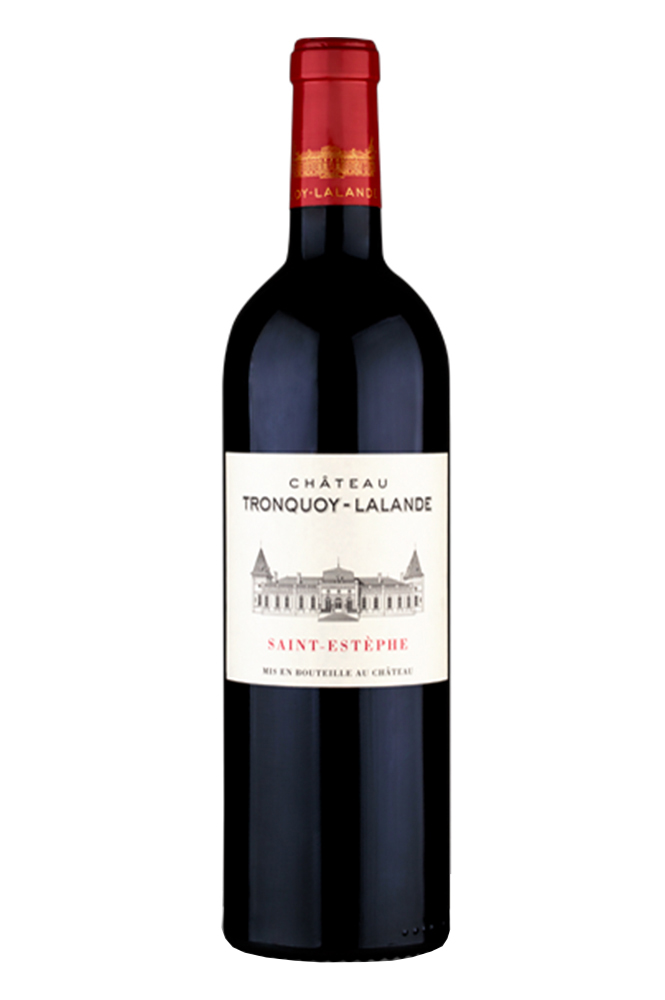
Château Tronquoy-Lalande
The 2018 vintage was a real statement vintage for Château Tronquoy-Lalande.
At the 2022 Southwold Tasting (the most comprehensive blind tasting of Bordeaux wines, organized annually and judged by a team of leading critics in London), the wine dominated its price category and proved to be king: Jancis Robinson MW blind-rated Château Tronquoy-Lalande 2018 with 18.5/20 points. Tronquoy-Lalande thus beat the wines of Margaux, Lafitte and Haut-Brion, while Latour and Mouton were on a par with the château. A series of 93-point scores from other leading critics opened up the debate as to whether this could be the best value-for-money wine produced in Bordeaux in 2018.
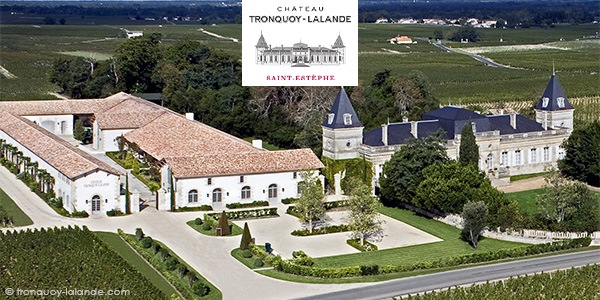
Château Tronquoy-Lalande is located in Saint-Estèphe. Its roots go back to the year 1745. The estate was acquired by Martin and Olivier Bouyguese in 2006. The two brothers have made their fortune in the construction and telecommunications sectors, among others. They also own the second growth Château Montrose in the same appellation as well as Clos Rougard in the Loire and Domaine Henri Rebourseau in Burgundy.
After the acquisition, the vineyard began to be carefully replanted. Biodiversity became a new cornerstone, a forest was planted and beekeeping was started. The vineyard was converted to organic farming and the aim is to be certified by the 2024 harvest. The estate building and cellar were also renovated and redesigned, with 22 steel tanks now replacing the old concrete tanks. The renovation work was completed in 2010. The château has been run by estate director Yves Delsol for more than thirty years.
The 30 hectares of vineyards are planted in a block on a hill 23 meters above sea level and grow on clay and pebble soils with a plant density of 9,000 vines per hectare. The relatively large pebbles in the vineyard are strongly reminiscent of the soils in Châteauneuf-du-Pape. The high proportion of Merlot is special for a Rive Gauche estate: 52% Merlot, 39% Cabernet Sauvignon, 6% Petit Verdot and 3% Cabernet Franc.
Due to the high proportion of Merlot, the wines are ready to drink a little earlier with juicy fruit and rather charming tannins for the appellation, but also with good ageing potential. Since the 2012 vintage, the wines are no longer sold en primeur, but only once they have been bottled.
We are also big fans of this Château and the 2018 vintage also appealed to us, which is why we can also offer it in various formats as follows: